Unknown block type:
SchoolHeaderUnknown block type:
SchoolNavSchoolHeaderSchoolNavPiptrex, launched under your brand on web, iOS and Android — with your CRM, your wallets and your partner tree already sitting behind it.
Get Your DemoWhat your traders get
The screen your clients spend their day on. Six things it has to get right before anything else matters.
Browser, iOS and Android built from the same platform rather than three products kept roughly in step. A client who opens a position on a laptop finds it on their phone looking the way they left it, with the same order types available on both.
Streaming prices, depth, indicators and drawing tools that stay put between sessions. Traders judge a platform in the first minute on whether the chart feels alive, and no amount of back office makes up for it if it does not.
Balance, equity, margin, open positions and history are on the same screen as the order ticket. A client should never have to leave the terminal to find out what they can afford to trade next.
Deposits, withdrawals and transfers between accounts run inside the terminal on the payment rails you have enabled, so a margin call is answered in the moment rather than after a trip to a separate portal.
Your logo, colours and wording, on your domain, in an app published under your own developer account. Nothing on the terminal says which platform you licensed it from.
Pricing comes from your own liquidity providers with your markup applied, and the fill comes back to the same ledger your desk reports from. The terminal is the surface, not the source.
Where it runs
The same login, the same positions and the same money, wherever the client happens to be when they want it.
Nothing to install and nothing to support. The client clicks a link on your site and is trading in the same tab, which is why almost every first trade on a new platform happens here.
Where the volume actually is. Published under your developer account with your icon and listing, and carrying push alerts on fills, margin and deposits so a client hears from you before the market tells them.
The terminal dropped into a page of your own, behind your own navigation. Useful for desks whose marketing site is where clients already are and who would rather not send them somewhere that feels separate.
How it goes live
The two in the middle are ours. What sets the date is usually how quickly the first and the last get answered.
Which liquidity providers, which instruments and what markup on each. The terminal is only as good as what is quoting into it.
Logo, palette, wording, domain and the app store listing, applied to the web terminal and both mobile builds at the same time.
Accounts, wallets, KYC and the partner tree connect to the terminal, so an account opened in the portal can trade the moment it is funded.
Web terminal on your domain, apps through store review, and your desk trained on what clients will be looking at.
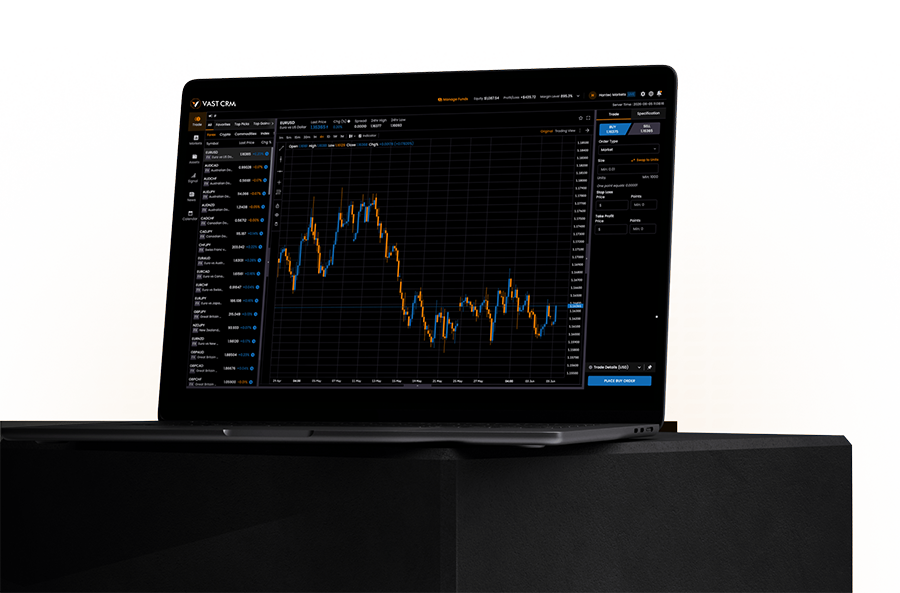
The terminal
Trading, funding and account management on the same screen, reading the same records your desk works from.
Questions about the terminal
What a desk asks before it moves its traders onto a platform of its own.
No, and most desks do not. The branded terminal runs alongside whatever else you offer — a client can hold an MT5 account and a terminal account at the same time, under one login, funded from one wallet, with both visible to your desk on one client record. Traders who want MetaTrader keep it; the ones who would rather not install anything get a platform that carries your name. Six platforms can run side by side without a second back office behind any of them.
Your own liquidity providers, aggregated and marked up on rules you set. We are not a venue and we do not sell you flow: the agreements and rates you have negotiated stay yours, several feeds can be combined into one book, and markup is configured per instrument, group, account type or client. Whatever a client was quoted is stored on the trade, so the revenue reported against a fill and the price the client actually saw never drift apart.
Yours, on your own developer account, with your icon, screenshots and listing copy. We prepare the builds and the store assets and stay with you through review, including the rejections both stores hand out to financial apps over disclosures and account deletion. Platform updates from Apple and Google are absorbed on our side. Because the account is yours, the listing, the reviews and the install base stay with you whatever happens to our arrangement later.
Yes, on the same rails as the client portal — cards, bank transfer, UPI, e-wallets and crypto, whichever you have enabled for that client’s country. Deposits post to the wallet as soon as the provider confirms and reach the trading account in the same step. It matters more than it sounds: a margin call answered inside the terminal is a position saved, and one that needs a trip to a separate portal is often a position closed.
They come across with their history. Client records, accounts, verified documents, balances and the partner tree migrate together, so somebody signing in after the move finds the account they had rather than a blank one. Existing platform accounts keep working throughout, which means a desk adding a terminal is not also asking its clients to change how they trade in the same week they are asked to learn a new login.